

Franchise vs. Startup: Which Business Path is Right for You?
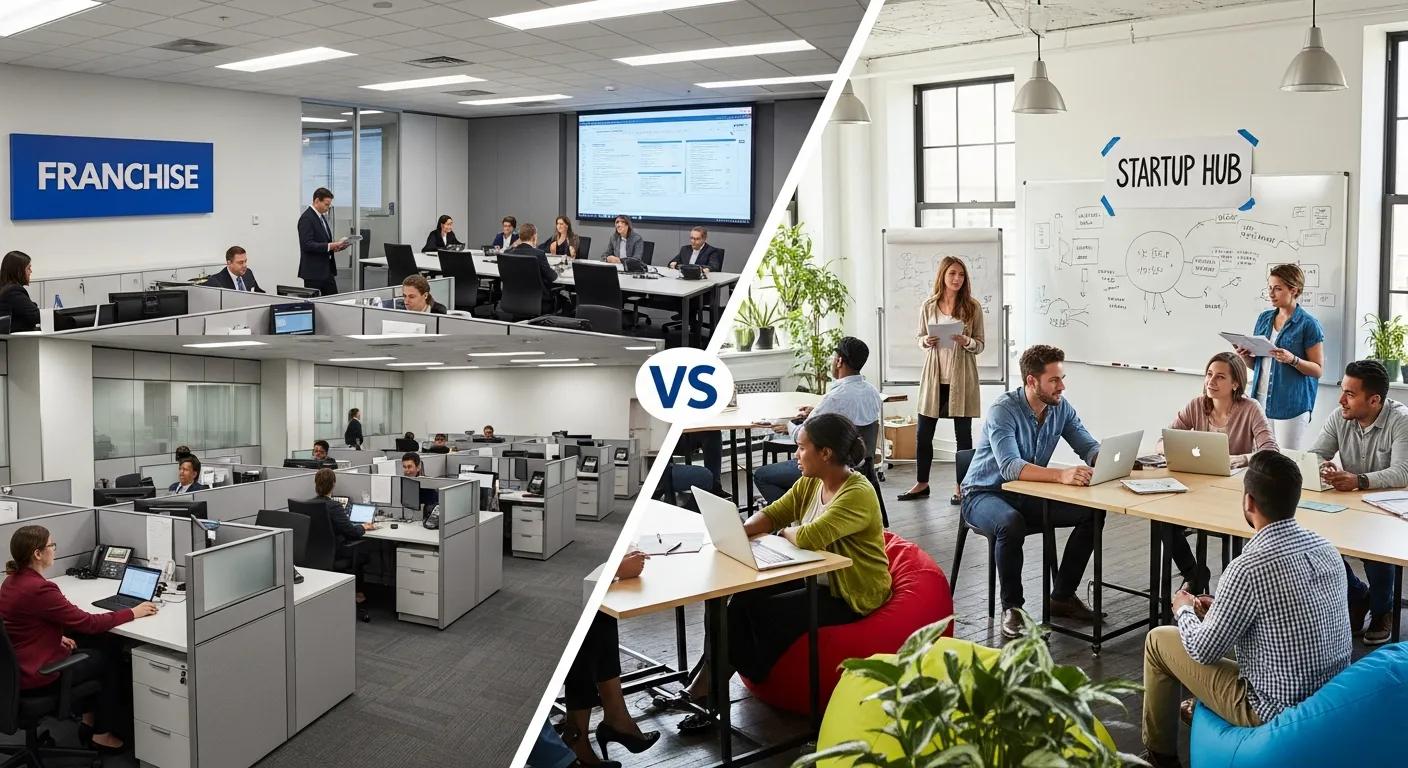
Franchise vs. Startup: Which Business Path is Right for You?
By comparing structured support systems against the autonomy of a private enterprise, entrepreneurs can better navigate and identify which path aligns with their capital, lifestyle goals, and professional experience.
Choosing between a proven business model and an independent venture is a pivotal decision for any aspiring entrepreneur. While a franchise provides immediate brand recognition, turnkey operations, and corporate mentorship, a solo venture relies entirely on founder-driven innovation and flexible strategy. Evaluating this choice requires a deep dive into financial commitments, operational control, and long-term scalability.
By comparing structured support systems against the autonomy of a private enterprise, entrepreneurs can better navigate business ownership risks and identify which path aligns with their capital, lifestyle goals, and professional experience
What Are the Key Differences Between a Franchise and a Startup?
A franchise is a licensed replication of an established business model where the franchisor provides branding, operating systems, and training; a startup is an independent venture where founders create and test a market-fit offering. The mechanism that makes a franchise work is standardized processes and brand equity that shorten customer acquisition time, while startups rely on experimentation, pivots, and founder equity incentives to find scalable growth. For many entrepreneurs, the choice hinges on whether they prefer operational certainty and support or creative control and potential equity upside. Below is a comparison that highlights the core attributes to consider when weighing franchise vs startup for business ownership.
Intro to comparison table that highlights practical attributes for quick evaluation.
| Aspect | Franchise | Startup |
|---|---|---|
| Brand | Established recognition | Built from scratch |
| Support | Franchisor training & systems | Founder-created processes |
| Cost | Upfront fee + royalties | Variable startup costs |
| Risk | Lower early-stage failure risk | Higher early failure risk |
| Autonomy | Limited creative control | Full control and flexibility |
This table clarifies that franchises trade some autonomy for predictability, while startups trade predictability for control and potential upside. Understanding these core differences narrows your evaluation to financial capacity, risk tolerance, and lifestyle goals.
How Do Business Models Differ Between Franchises and Startups?
Franchise business models operate through a franchisor
franchisee relationship: the franchisor licenses a repeatable system, and the franchisee pays fees and royalties in exchange for brand use and ongoing support. This mechanism lets franchisees focus on execution rather than invention, which often results in faster ramp-up and more predictable early revenues. A simple example is a fast-casual food franchise where the franchisor supplies menus, supplier networks, and marketing campaigns while the franchisee manages local operations and staff. Understanding this relationship helps you evaluate operational expectations and contractual obligations before committing.
What Are the Typical Risks and Rewards of Each Option?
Franchises typically present lower early-stage market risk because of brand recognition and tested operations, but they carry financial obligations like initial franchise fees and ongoing royalties that reduce margin. Rewards for franchisees include faster customer trust and franchisor-led marketing; risks include restricted creative control and contractual limits on suppliers or territory. Startups offer potential for significant equity appreciation and full strategic control, yet they face higher failure rates, unpredictable revenue, and intense funding demands. These trade-offs mean entrepreneurs must weigh immediate stability against long-term upside.
Evaluating the Pros and Cons of Franchise Ownership

It bundles tangible benefits training, marketing, and buying power with obligations such as franchise fees, royalties, and adherence to brand standards. The mechanism that reduces operational risk includes franchisor training curricula, field support, and national campaigns that lower customer acquisition cost and speed time-to-revenue. For investors who prioritize predictable operations and risk mitigation, franchising can be an efficient path to business ownership, though it requires careful financial analysis of fees, royalties, and cash flow projections. Below is a table that clarifies common benefits and risks with concrete examples and attributes.
Intro to franchise benefit-risk table: this EAV-style table clarifies financial and operational trade-offs.
| Benefit / Risk | Attribute | Example / Value |
|---|---|---|
| Benefit: Training & Support | Operational | Franchisor training programs and manuals reduce onboarding time |
| Risk: Initial Fee | Financial | Typical franchise fee can be a significant upfront cost |
| Risk: Ongoing Royalties | Financial/Operational | Percentage of sales paid to franchisor affects margins |
This table shows that support reduces operational risk while fees and royalties require upfront capital planning and margin analysis. For entrepreneurs ready to evaluate specific franchise opportunities, GG the Franchise Guide offers personalized consulting to assess fit, risk, and potential matches. Book Your Call, Identify Your Goals, Get Franchise Matches, Navigate the Process
How Does Franchise Support and Brand Recognition Reduce Risk?
Franchise support reduces early-stage risk through structured training, proven supplier relationships, and centralized marketing that drives consistent traffic. Training ensures operators follow repeatable processes that have been refined across other locations, while supplier agreements often lower input costs and improve quality control. Brand recognition accelerates trust and shortens the sales learning curve, which can materially improve the probability of reaching break-even sooner. Recognizing how these elements work together helps quantify why many franchisees experience lower early failure rates compared with independent startups.
What Financial Investments and Ongoing Fees Are Involved?
Typical financial commitments for buyers include an initial franchise fee, real estate or build-out costs, equipment, and a working capital reserve; ongoing costs often include royalty fees and contributions to national marketing funds. Financing options differ from startups because franchisors sometimes offer lender introductions or preferred financing, but you should always model conservative revenue scenarios. Create a simple pro forma that lists initial fees, projected monthly royalties, and expected working capital runway to understand cash flow sensitivity. This financial clarity prevents unexpected shortfalls and supports negotiation points during due diligence.
What Are the Pros and Cons of Starting an Independent Business?
Starting an independent business grants full creative control, flexible branding, and the ability to capture all equity gains, but it places the burden of model development, customer acquisition, and systems design entirely on the founder. The mechanism behind this new risk is iterative market testing: founders must validate product-market fit through MVPs and early customer feedback, which can be time-consuming and capital intensive. For entrepreneurs who value autonomy and ownership and who are comfortable with uncertainty, startups can deliver outsized returns; for those who prefer operational systems and reduced early-stage risk, franchising may be preferable. The following lists summarize common pros and cons to consider.
Indeed, achieving product-market fit is a critical determinant of a new business’ long-term viability and success.
New Venture Success: The Role of Product-Market Fit
Obtaining product-market fit continues to make the difference in the success or failure rate of startups, especially in a regulated and competitive industry like Germany. It is a study of how customer development strategies help to understand product-market fit in a region of an entrepreneur ecosystem.
Enhancing Product-Market Fit through CustDev: A Regional Perspective on Startup Development, 2025
Independent startup pros include autonomy, potential for higher ROI, and flexible pivots; cons include higher failure risk, funding needs, and longer branding timelines.
- Autonomy: Full control over product, pricing, and brand direction.
- Equity Upside: Founders retain all value created by growth and exits.
- Flexible Strategy: Rapid pivots and experimentation to pursue product-market fit.
How Does Autonomy and Creative Freedom Benefit Startup Owners?
Autonomy enables founders to iterate on product features, test pricing models, and shape company culture quickly, which can be decisive when finding market fit. This freedom supports differentiation strategies that may yield premium margins and customer loyalty if executed well. However, autonomy also means responsibility for developing systems that franchisors normally provide, from HR to supplier contracts, which increases operational workload. Entrepreneurs should weigh whether the strategic advantages of full control outweigh the operational overhead and uncertainty inherent in early-stage ventures.
What Challenges and Risks Do Startups Commonly Face?

Startups typically face difficulty securing consistent financing, building brand awareness, and achieving repeatable customer acquisition, which together drive a higher early failure rate. Founders must manage cash burn, hire core talent, and often pivot based on real-market feedback, each of which consumes time and capital. Practical mitigations include launching an MVP, seeking strategic partnerships, and using staged funding to extend runway while validating assumptions. These risk-management tactics narrow the gap between experimentation and scalable growth.
How Can You Choose Between a Franchise and a Startup?
Choosing between the two reduces to a decision framework that matches your risk tolerance, capital availability, desired level of control, and long-term goals. The mechanism for making this choice is a simple checklist that prioritizes financial runway, lifestyle expectations, industry experience, and exit strategy; applying the checklist yields a preliminary recommendation you can test with advisors. Use the questions below as a decision checklist to guide your assessment and to create an action plan for next steps if you decide to pursue franchise ownership or build an independent venture.
Navigating the complexities of entrepreneurial choices, especially in uncertain environments, underscores the importance of a robust decision-making framework.
Entrepreneurial Decision-Making in Uncertain Environments
Decision-making in entrepreneurial setting becomes difficult and challenging because of many unknowns requiring knowledge of contextual intelligence and changing business environment, further accentuated in emerging economies because of regulatory uncertainty and change. Right decision-making is key to profitable exit or early disengagement, resulting in reduced sunk cost.
A decision-making framework for entrepreneurial venture in emerging economies, 2022
Use this checklist to weigh your personal and financial fit before committing.
- Risk Tolerance: Do you prefer predictable systems or high upside with uncertainty?
- Capital & Runway: How much cash can you invest without jeopardizing finances?
- Control vs Support: Do you want full creative control or structured guidance?
- Experience & Lifestyle: Does your background align with industry demands and time commitment?
This checklist quickly reveals whether you lean toward franchise stability or startup freedom and helps prioritize next steps like market research, pro forma modeling, and expert consultation. For tailored guidance and personalized franchise matches, GG the Franchise Guide can help evaluate options and next steps. Book Your Call, Identify Your Goals, Get Franchise Matches, Navigate the Process
What Personal Factors Should Influence Your Decision?
Key personal factors include your tolerance for ambiguity, available financial runway, career stage, family obligations, and desired exit timeline; each affects how much risk you can take and how hands-on you can be. Reflective questions such as whether you prefer predictable monthly income or the possibility of a large future payout translate these factors into practical selection criteria. Prioritizing these factors clarifies which business model aligns with both your financial and lifestyle goals. Use your answers to narrow focus to industries and ownership structures that fit your constraints.
How Can Expert Guidance Help You Make the Right Choice?
An experienced advisor helps translate checklist results into concrete opportunities by providing franchise matching, objective risk assessment, and practical due diligence checklists that cover financial, legal, and operational issues. Advisors can also connect you with financing resources and model realistic cash flow scenarios so you understand break-even timelines and sensitivity to royalties or rent. If you want help assessing franchises that fit your profile, consider consulting with GG the Franchise Guide for personalized matching and guidance through the selection process. Book Your Call, Identify Your Goals, Get Franchise Matches, Navigate the Process
For a final step, if you want personalized help comparing franchises or exploring new pathways with expert support, GG the Franchise Guide, led by Giuseppe Grammatico, provides free consulting and a streamlined process to evaluate fit and next steps. Book Your Call, Identify Your Goals, Get Franchise Matches, Navigate the Process